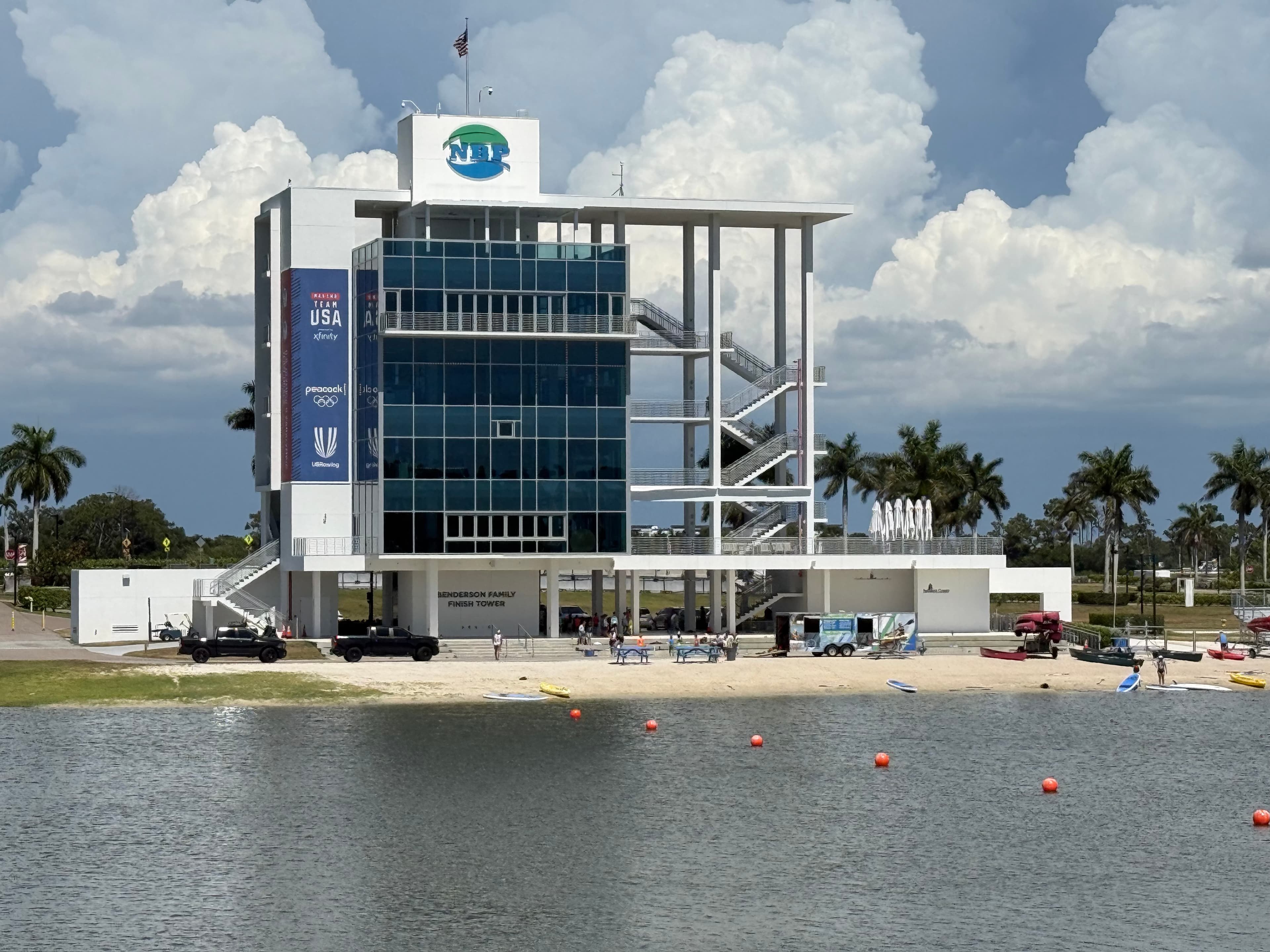
Volunteering at Nathan Benderson Park — NBP
Confessions of a last-minute volunteer at Nathan Benderson Park — from Crow's Nest lookout to my favorite role of all: Stakeboat Holder.
As a member of the Sarasota Crew Masters program we could choose between a non-discounted monthly dues plan or, if we volunteered 20 hours a year at NBP, a discount on those dues. I signed up for the volunteer plan to get the lower membership rate and promptly forgot about the 20 hour requirement. Then one day, with only two events left in the year, I received an email stating I had not fulfilled my 20 hour volunteer quota. I reviewed the remaining events and signed up for several shifts, completing my volunteering in a single weekend.
I experienced several different positions, such as "Crow's Nest Look Out," where you stand on the top deck of the Finish Tower with binoculars and a walkie-talkie radio. Your job is to watch for rowers who have just finished a race and follow them back through the canal to the docks, making sure no one is experiencing any physical issues after essentially sprinting for 1,000–2,000 meters. All of this is done while standing in the direct Florida sun, baking on top of the Finish Tower. An important role for sure, but not all that much fun or stimulating physically or mentally. For another shift, I handed out and retrieved bow numbers as teams moved their shells onto and off the race course. This was similar to the "Look Out" role — important, but not exactly exciting. I should say, though, that all the volunteer roles are important. It takes hundreds of volunteers to run a successful rowing competition at NBP, or any other venue for that matter.
Without regattas, which bring in significant revenue and economic impact to the surrounding area, the rowing venue at NBP would most likely not exist. Teams — sometimes hundreds of them — bringing thousands of spectators are what make the economics of the Rowing Center at NBP possible, along with programs like SRQ Crew Masters and many others.
So, I am incredibly grateful for the venue, the programs, and the people who make it all happen. They create the opportunity for me to participate in something I enjoy and benefit from so greatly.
During my scramble to fulfill my yearly volunteering in a weekend, I signed up for a shift as a "Stakeboat Holder." Yea, I didn't know what that was either. There are primarily two types of starts in rowing. Floating — where the teams line up in their assigned lanes and attempt to keep their shells pointed down course and even with the other teams while getting pushed around by currents, winds and potentially wakes from other traffic on the water. The other is a more fixed start from a dock, where the stern (back) of the shell is held by a person, or "Stakeboat holder," lying prone on the dock and hanging onto the tip of the stern and, via a radio headset, being told by the "Race Aligners," "lane 3 pull your boat in 3 inches, lane 6 push your boat out 1 foot," until all the shells in that heat are lined up. You might think, why is that necessary? And the answer is: not all shells are the same length. Yes, that's right — not all Quads (4x), four-person shells, or any class of shell (1x, 2x, 8+ and their variants) are the same length!
Stakeboat Holding is my favorite volunteer role, and it is all I have volunteered for since my first shift doing it. There is ALWAYS something to do; races are typically every 8–10 minutes, and within approximately 2 minutes of the start of one race the next heat or flight, as they are called, of teams is entering the starting area and proceeding to get "locked on" (the stakeboat holder having a grip on their stern, and if the Boot System is used then they are getting set in that also). Teams can be disqualified if they are not "locked on" within a certain time period. Windy conditions and inexperienced crews or Stakeboat holders can greatly complicate this process.
The power and energy is palpable — truly a sight to behold.
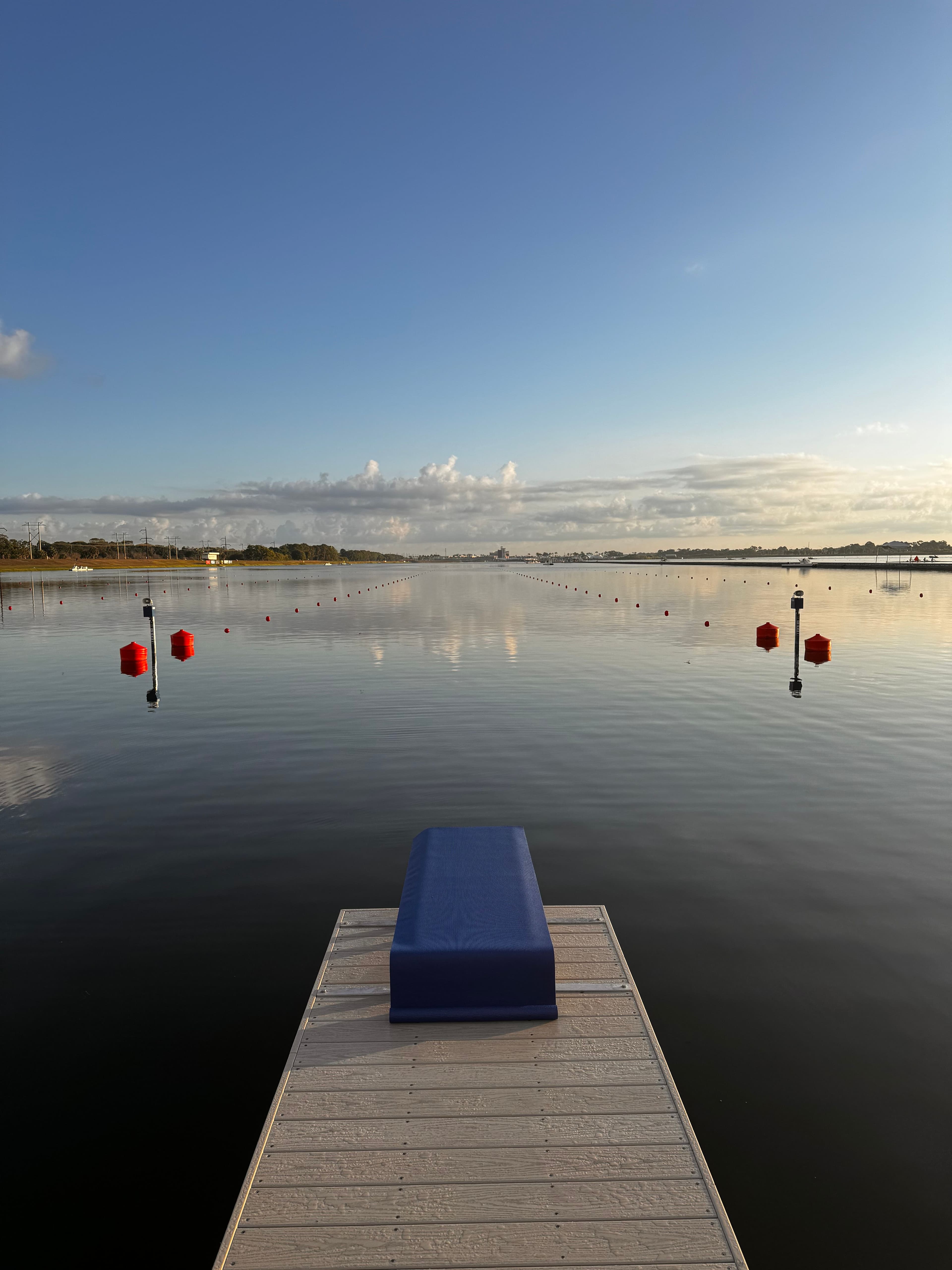
When a high-stakes regatta is taking place — such as the University of Washington (of Boys in the Boat fame — see the book review in our Books section) versus Harvard, Yale, and Princeton, the NCAA National Championships, the U.S. National Team Time Trials, etc. — or when the winds are strong enough to create challenges but not strong enough to cancel racing, a Boot System is used.
The Boot System is a device that rises from underwater to hold each boat's bow steady and precisely aligned with the other lanes, ensuring that no team has an advantage at the start. It prevents any one boat from being even an inch farther up the course than another, creating a perfectly fair starting line for every crew.
Here is how I describe the system to others who have never done Stakeboat holding:
Imagine laying prone on a dock for, say, an 8+ race. The teams back into the lane, you grab the stern, and they are now "locked on." Once all teams have done this they raise the "Boot," which is a clear Lucite U-shaped device, and your job is to put the bow of the shell into it. This is akin to threading a needle, except that the eye of the needle is 65–70 feet away and, blocking your view of it, is your thread: a shell with 9 people (8 rowers and the coxswain), roughly 60 feet long and able to weigh 2,000 +/- lbs. It is not as intimidating as you may think, unless you get freaked out when doing something really important with a very short time — 30 to maybe 60 seconds — to accomplish it. Once you've done it a few times you develop an awareness or feel for the process and it really is pretty simple.
Once all the shells are locked on and all bows are in the boots, there's typically 3–4 minutes to the start, and you just lay there keeping some pressure on the stern so that the bow does not come out of the boot. You then hear the starter announce each team by name, by voice, from lane 0 up to 9, or whichever lanes are in use for that race. Then the Starter says "Attention…" — pauses — "GO!" Often accompanied by a green light the crews can see and a loud tone. To be so close to these shells — any closer and you'd be in the shell — when they start will give you chills. The power and energy is palpable! It is truly a sight to behold, and there is no better perspective from which to experience this than from the Stakeboat Holder position. Imagine sitting on the start gate for the Kentucky Derby when the doors fly open and 20 horses go from zero to 40mph! An 8 person shell won't hit 40mph but will top out around 14mph, still very fast for what it is, and it is 2x the weight of the typical Derby horse.
Volunteering is fun; you meet all sorts of people from all over the country, and the rowing community seems to be full of amazing, friendly, giving people! I was walking to the rowing center for a shift wearing our NBP Volunteer shirt and was thanked by a few spectators who were there to watch their son and daughter compete. Knowing you're helping other rowers enjoy the same sport you do, for all the same reasons, makes helping total strangers very fulfilling. Most members of SRQ Masters are very committed to volunteering at NBP, and we have a great time together doing so. We organize to help in specific roles and gather before and after with way too much food, fun and laughter.
Share this
Rowing is Life