
Photo: Lindsay Schoop
The Common Denominator of Success
Albert E.N. Gray's 1940 speech on the one true secret of success — habits, subconscious paradigms, and why the conditions are never ideal — and what it has to do with a 6am row.
During a conversation with some of my rowing friends, a comment triggered a recollection of a speech given by Albert E.N. Gray in 1940 to a group of life insurance executives about why some salespeople outperformed others — often by extremely wide margins.
Gray's speech was titled, as is this post, "The Common Denominator of Success." In it, he described his search for why some succeed and some don't as necessary for his role as a sales manager at an insurance company. But before you think… this is a rowing blog or I don't sell anything, let me assure you: the common denominator applies to every area of human endeavor, and of all the "secrets of success" there might be, this is truly the only one you need. It is not hard work — hard work, like several of the other "secrets," is certainly required, but it is not the root cause of success. Hard work is not the common denominator.
Before I spill the beans on what it is, a key point to why Gray discovered it in the first place is worth understanding. It's simple, why he discovered it is because that is exactly what he was looking for. As the saying goes, "seek and ye shall find." How will you get somewhere if you don't have a specific destination in mind? I tell my kids that most people don't set out in life to achieve a specific thing — a career as a doctor, a lawyer, whatever. Often, in terms of lifestyle or income, it's defined loosely as "better and more" than their parents had. Since they never specified where they wanted to go in life, they end up somewhere that doesn't come close to their own loosely defined goals — and I believe that's the root cause of the infamous midlife crisis. People wake up one day and wonder, "How the hell did I end up here?!" The answer is: because they never intended to specifically end up anywhere else.
Now let's get to what you're all reading this for: the common denominator of success! It is simply that the secret of success of every person who has ever been successful lies in the fact that they formed the habit of doing the things that failures don't like to do. Like it or not, it will still be the secret, the common denominator.
The secret of success of every person who has ever been successful lies in the fact that they formed the habit of doing the things that failures don't like to do.
This is why Lauren Henry (Great Britain) can win an Olympic gold medal in the Women's Single Scull (1x) standing at 5'6½", and not some 6-footer with the "ideal" 6'3" wingspan.
So why do the successful people in life seem to like doing the things that failures don't like to do? They don't. Liking the things has nothing to do with it — the things that make you successful are mostly universally disliked by all humans. In rowing terms, it's climbing out of a warm bed at o-dark-thirty in the morning, driving 10, 20, 30 minutes to the boathouse even when the wind speed looks too high, the temp is too cold, it looks like rain, there's lightning in the vicinity. Some will see those conditions, hit snooze, and send a text: "Team, I'm not gonna make it because [fill in the blank], but I'm gonna erg at home." That's not always the wrong call, but it's virtually never the ideal one. Why? Because you'll miss the opportunity to learn something — from your coach, your teammates, yourself — things that can only be caught if you're at practice. You'll miss the gold nugget that could lower your splits by 10–20 seconds. Or you just miss the opportunity to strengthen your resolve and perseverance, your willingness to accept challenging conditions and do it anyway — because when in life are the conditions ever ideal for anything?
Habits
Let's discuss habits for a moment. Ralph Waldo Emerson is often credited with saying:
"Sow a thought and you reap an action; sow an act and you reap a habit; sow a habit and you reap a character; sow a character and you reap a destiny."
Have you ever heard someone say, "I'm sorry, that was force of habit"? What they were really saying was, "I'm sorry, I just did that — I consciously knew I didn't want to, or shouldn't have, but I did it anyway, because my habit of doing that is stronger than my conscious thought that I shouldn't." That is the power of habit. Imagine building such powerful habits around the things that lead to success that doing them becomes part of who you are. You no longer have to rely on motivation or desire — you simply do what needs to be done, because that's what you do.
It's said that 95% of our daily actions are driven by the subconscious mind — our paradigms, our habitual thoughts, our programming — and only 5% of our actions are conscious decisions made in the moment. Shockingly, those habits were given to you without your consent, and without regard to the destination in life of your own choosing.
Gray states that "every single qualification for success is acquired through habit." I've spent the better part of the last decade studying everything I could find on how the human mind — not the brain, but the mind — actually works. I was, let's say, of a "certain age," sitting at a week-long seminar in Toronto on the mind, when it hit me: the secret to success. I thought to myself, with my eyes getting strangely watery, "How can I be this age and have never known or been taught this before?" The more I thought about it, the madder I became. The anger was slowly replaced by the realization that from that point on, my success was solely up to me. From that day forward my life radically changed. Success was no longer a bitter slog of hard work, late nights, and what seemed to require a superhuman effort. It was easy, quick, and — for a while — oddly uncomfortable to suddenly have most of your dreams come true.
To the best of my knowledge, there are only two ways to develop or change your subconscious paradigms or habits. One is a major emotional impact — unfortunately, most major emotional impacts are negative: the sudden and unexpected passing of a spouse, a child, or a parent, for example. The second is consistent, spaced repetition — just like how we all learned our ABCs or our multiplication tables.
There's a lot written on how long it takes to make a habit — 21 days, 30 days, however many days. Take our Coach Lindsay's 30-day McGill Big 3 Challenge — it's absolutely a great stretching routine, and it will benefit you incredibly. But is 30 days enough to make it a habit? In my experience, the real answer to "how long does it take to make a habit" is: it depends. It depends on the person, on how emotionally motivated they are to change, and on how ingrained the habit is that they're replacing. You see, you aren't creating a new habit so much as you're replacing an existing one that either never served you, or no longer does — that no longer helps you get where you want to go. You will not change a habit unless, from the beginning, you link it to a definite purpose — a specific outcome that can be accomplished by keeping it. That outcome needs to be so important, so emotionally impactful, that just thinking about it will make your eyes tear up.
When you understand this, your future will no longer feel like a spin of the roulette wheel; life will no longer feel like a stomach-emptying ride on the wildest of roller coasters. Sure, all of life has cycles — ups and downs — but you'll know your path is true, and you'll not only survive but thrive because of those bumps in the road.
I was discussing an investment asset class recently, and my friend said something like, "Yeah, but it's so volatile." I replied, "You know what a non-volatile investment is called?" "What?" she said. "A savings account that pays almost 0% returns. Volatility is what produces returns." Look at a long-term (50–100 year) chart of the stock market, and it's obvious: the best days to invest are when the market is crashing.
- Jul 8, 1932 — 4.43: Great Depression bottom (predecessor 90-stock index)
- Apr 28, 1942 — 7.47: WWII low, following the Pearl Harbor shock
- Jun 13, 1949 — 13.55: Post-WWII economic readjustment low
- Oct 22, 1957 — 38.98: “Eisenhower Recession” / Sputnik panic bottom
- Jun 26, 1962 — 52.32: The “Kennedy Slide” flash-crash bottom
- Oct 7, 1966 — 73.2: Tight credit crunch / Vietnam-era low
- May 26, 1970 — 69.29: Penn Central bankruptcy / recession trough
- Oct 3, 1974 — 62.28: Stagflation, Nixon resignation, OPEC oil crisis low
- Aug 12, 1982 — 102.42: Volcker rate-hike bear-market bottom
- Dec 4, 1987 — 223.92: Trough of the 1987 Black Monday crash
- Oct 11, 1990 — 295.46: Gulf War oil spike / 1990 recession low
- Oct 9, 2002 — 776.76: Dot-com bubble collapse bottom
- Mar 9, 2009 — 676.53: 2008 Global Financial Crisis low
- Mar 23, 2020 — 2,237.4: COVID-19 lockdown panic low
- Oct 12, 2022 — 3,577.03: Fed inflation-fighting rate-hike low
Values before 1957 reflect the S&P 500's predecessor (a 90-stock composite index). All figures approximate except the 15 marked bottoms. Not investment advice.
The good news is: "Your future is going to depend on your purpose in life — over which you have every control."
Unfortunately, it's easier to become accustomed to a low standard of living than to the hardships of making a better one — which is the exact reason so few people ever change. It's why gyms are full to capacity on January 3rd and a virtual ghost town by early April: people with good intentions, but no strong emotional link to a vivid image of what the outcome will mean for their life, succumb to the excuses of [fill in the blank]. The result has to be emotional or sentimental — there is no power in logic, no magic in logic. I mentioned to a friend recently that I absolutely drool over the Bentley Continental. She replied, "It's nice, but impractical — who would transport your bike, haul your kayak and paddleboards?" She correctly knew I'd never put any of that on or in any Bentley I owned! Who really needs a $350,000–$400,000 car? No one — but plenty of people want one, and none of it is logical. Tony Robbins will tell you that people make decisions for emotional reasons and justify those decisions with logic.
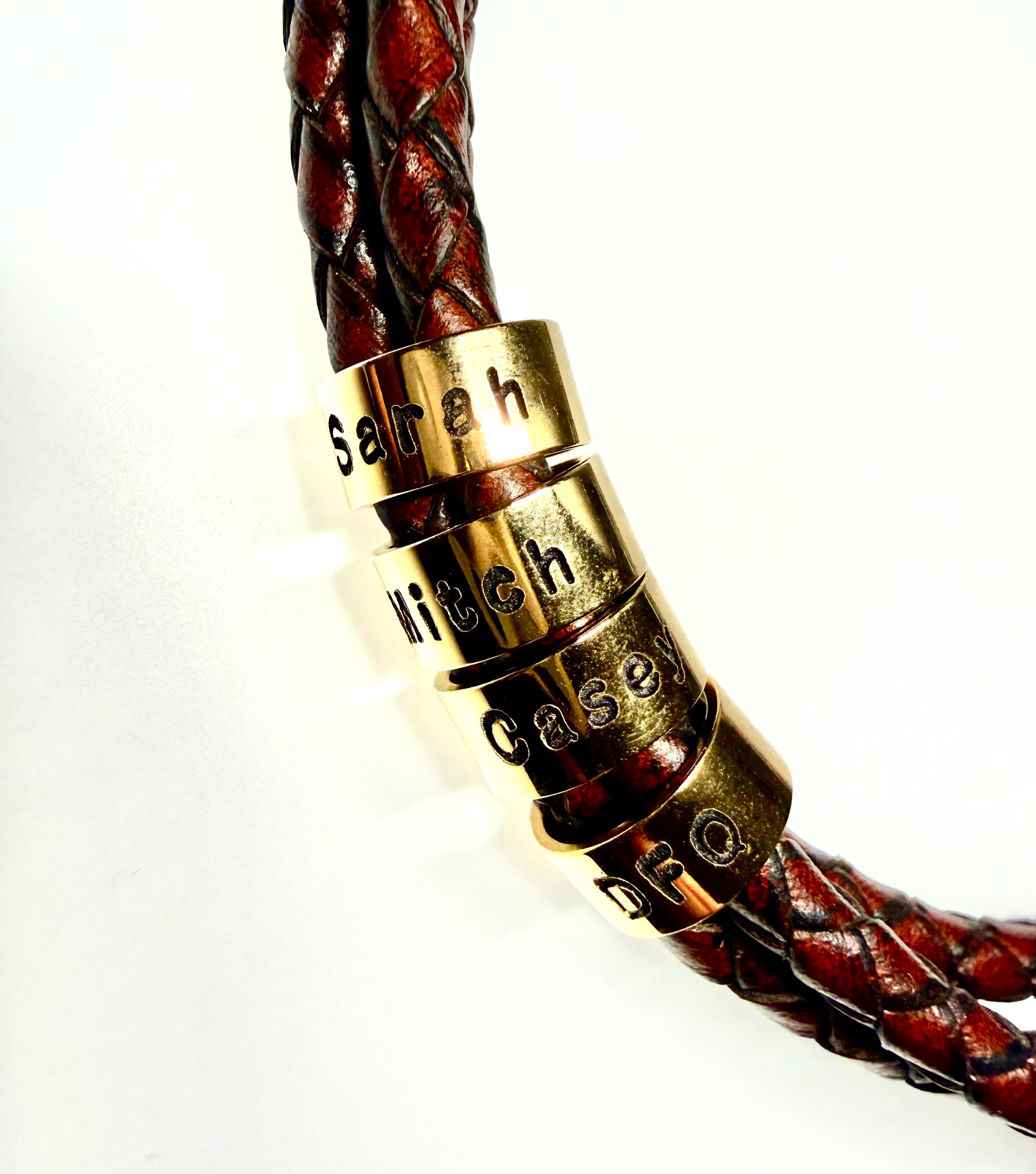
My emotional reason is on my wrist. I wear a bracelet with gold bands stamped with my kids' names — Sarah, Mitch, Casey — and a fourth band stamped DFQ: Don't F'ing Quit. Those three names are the vivid image; the fourth band is the promise that goes with them — never quit striving to be an example worth following. On the mornings when the wind is up and the bed is warm, logic always has a good argument ready. The bracelet doesn't argue. It just reminds me who's watching.
I'll end this the same way Albert E.N. Gray ended his talk:
"...if it's an honest purpose, you will be honest and honorable in the accomplishment of it. But as long as you live, don't ever forget that while you may succeed beyond your fondest hopes and your greatest expectations, you will never succeed beyond the purpose to which you are willing to surrender. Furthermore, your surrender will not be complete until you have formed the habit of doing the things that failures don't like to do."
You can read Gray's full 1940 speech here: The Common Denominator of Success (PDF)
Share this
Rowing is Life